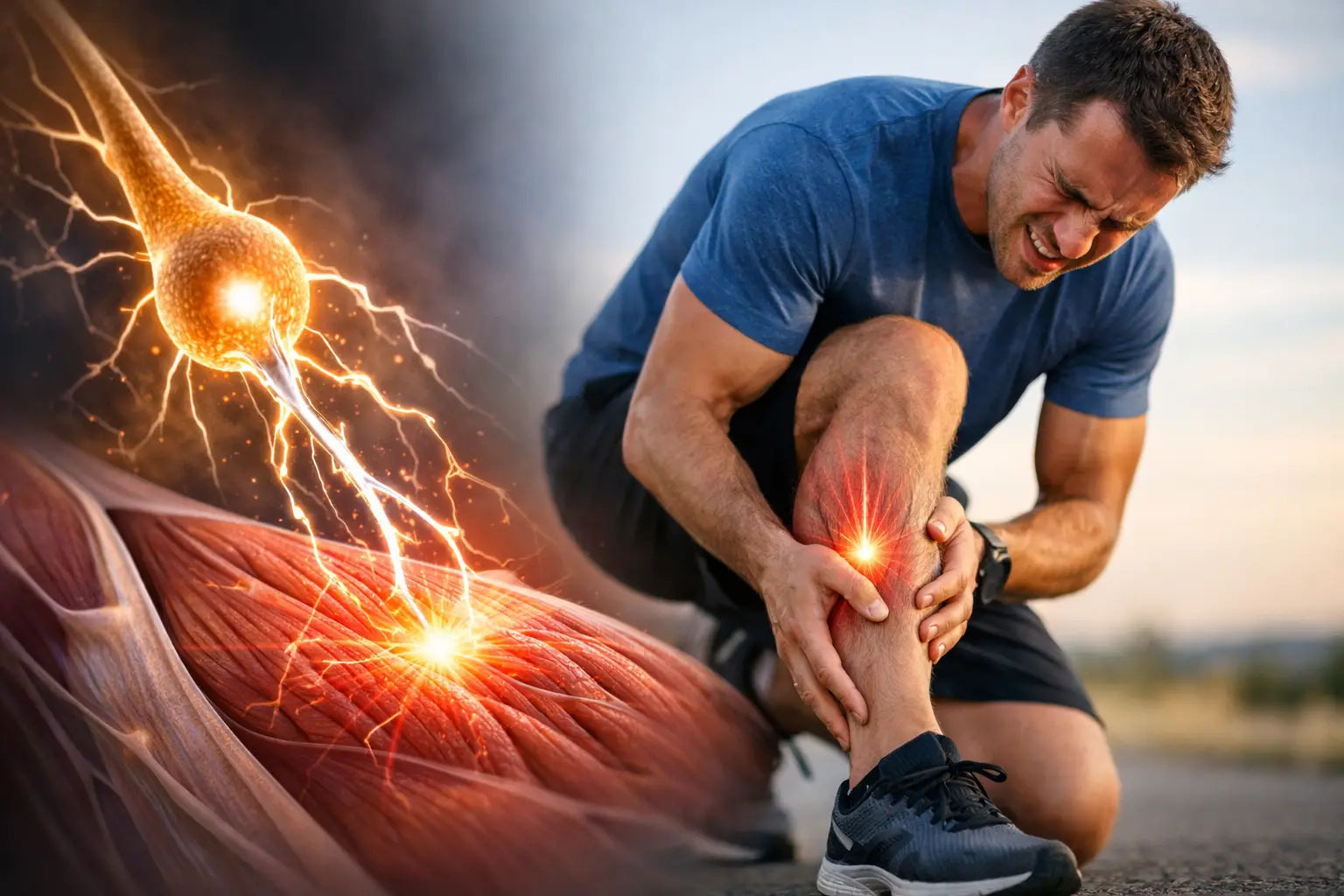
A calf cramp in the final mile does not feel like a minor inconvenience. One second, your stride is locked in. The next, the muscle grabs hard, your foot points involuntarily, and continuing feels impossible. Understanding how nerve signals trigger muscle cramps changes the response: a cramp is not always a hydration failure. Often, it is a nervous-system problem happening in real time.
That distinction matters whether cramps interrupt your training, wake you from sleep, or show up after a long day on your feet. You need more than vague advice to drink water and hope for the best. You need to know why the muscle is stuck contracting - and what can help it release.
A muscle cramp starts with an overactive signal
Your muscles do not contract on their own. Every voluntary movement begins with a message from the nervous system. A motor nerve sends an electrical signal to the muscle at the neuromuscular junction, where it releases a chemical messenger called acetylcholine. That message tells muscle fibers to shorten.
Normally, this is a tightly managed system. Your brain tells a muscle to work, sensory receptors report how much force and stretch the muscle is experiencing, and the nervous system adjusts the output. Contract, relax, repeat.
During a cramp, that balance breaks down. Motor neurons that activate the muscle become too excitable, firing repeated signals even when you are trying to stop moving. The result is a powerful, involuntary contraction that can last seconds or minutes. The hard knot you feel is muscle tissue receiving a persistent command to stay on.
A cramp is not simply a sore muscle. It is an electrical control problem with a painful physical result.
The push-pull system that usually prevents cramping
Two sensory systems help regulate muscle activity. Muscle spindles detect stretch. When a muscle lengthens quickly, they can encourage it to contract to protect it from overstretching. Golgi tendon organs, located near the muscle-tendon connection, sense tension and can help reduce muscle activation when force gets too high.
Think of one system as an accelerator and the other as a brake. In a fatigued muscle, the accelerator can become more sensitive while the brake becomes less effective. That raises the odds of an involuntary contraction.
This helps explain why cramps often strike when a muscle is working near its limit: sprinting up a hill, kicking late in a game, holding a demanding yoga position, or pushing off repeatedly during a long swim. The muscle is fatigued, the nervous system is working hard to coordinate it, and the feedback loop becomes less stable.
Why stretching can bring relief
Stretching a cramped muscle can help because it changes the sensory input traveling back to the spinal cord. For example, gently pulling your toes toward your shin during a calf cramp lengthens the calf muscle and increases tension through the tendon. That can strengthen inhibitory feedback and reduce the motor neuron firing that is keeping the muscle clenched.
It is not magic, and it may not work instantly every time. But it targets the signal behind the contraction rather than asking a locked muscle to simply will itself open.
Why dehydration and electrolytes are not the full story
Hydration matters for health and performance. Significant fluid loss, heat stress, and sodium loss can affect how your body functions and may contribute to cramping in some situations. Replacing fluids and electrolytes is smart preparation for long, hot, or high-sweat sessions.
But the popular idea that every cramp means you are deficient in water, potassium, magnesium, or sodium is too simple. Many athletes cramp even when they have followed a solid hydration plan. Others sweat heavily and never cramp. Night cramps can happen when someone is well hydrated and nowhere near a field, gym, or finish line.
For exercise-associated muscle cramps, fatigue and altered neuromuscular control are often major factors. Your risk can rise when you exceed your current conditioning, change pace abruptly, train in heat before acclimating, or repeatedly load a muscle in an unfamiliar way. A runner may cramp after adding hills too quickly. A cyclist may cramp after a hard late-race surge. A basketball player may cramp after repeated explosive efforts when fatigue has already changed their mechanics.
Electrolytes can still have a place in a performance plan. They are just not a guaranteed off switch for a cramp that is already being driven by hyperexcitable nerve signals.
How nerve signals trigger muscle cramps under fatigue
Fatigue is not only the feeling that your legs are tired. It can change the communication between muscles, tendons, nerves, and the spinal cord.
As a muscle tires, it may need stronger neural drive to keep producing the same force. At the same time, its normal protective feedback can become less effective. The motor neuron receives more excitatory input and less inhibition. That is the setup for a cramp: too much “contract” messaging, not enough “release” messaging.
This is why cramps can be so specific. Your entire body may be tired, but only one calf, hamstring, foot, or quad locks up. The vulnerable muscle is usually the one carrying the highest demand relative to its preparation. It may be crossing two joints, working in a shortened position, or absorbing more load than usual.
The same principle can apply to nighttime leg cramps. Prolonged positioning, muscle fatigue, certain medications, pregnancy, aging, nerve irritation, and some health conditions can change the system’s excitability. For many people, the exact cause is not obvious. What is clear is that a painful cramp does not automatically mean you failed to drink enough water that day.
What to do when a cramp hits
When the muscle locks, stop the activity that triggered it. Trying to power through a severe cramp can strain a muscle that is already contracting at full force. Gently stretch the affected muscle, then use light massage or easy movement once the spasm begins to release.
For a calf cramp, straighten the knee if possible and bring the toes toward the shin. For a hamstring cramp, carefully lengthen the leg and hinge forward only as far as is comfortable. Do not bounce, force an aggressive stretch, or turn a cramp into a bigger injury.
Then assess the bigger picture. Were you underprepared for the pace? Did you spike training volume, skip recovery, compete in unfamiliar heat, or repeatedly load one muscle group? That answer will do more for prevention than chasing a single miracle nutrient.
Some fast-acting oral approaches are designed to stimulate sensory receptors in the mouth and send a strong signal into the nervous system, with the goal of helping calm cramp-related motor activity. CrampsAWAY uses this neuromuscular approach in food-grade oral formulas designed for people who need fast, portable cramp support without relying on hormones or conventional pain medication.
Build a prevention plan around your real trigger
The best cramp strategy depends on when and why you cramp. If cramps appear late in hard efforts, progressive conditioning is often the highest-value fix. Build the duration, intensity, hills, heat exposure, or sport-specific workload gradually enough that your nervous system and muscles can adapt.
If you cramp during heat-heavy training, arrive hydrated and use a fluid and sodium plan that matches your sweat rate, session length, and conditions. If you get night cramps, regular calf and hamstring mobility, sensible training recovery, and attention to medication changes may help. People who cramp repeatedly in the same muscle may also benefit from evaluating strength, mobility, footwear, and movement mechanics.
Do not ignore frequent or unexplained cramps. Seek medical guidance if cramps are severe, persistent, associated with weakness, numbness, swelling, muscle wasting, dark urine, or a new medication. A clinician can help rule out circulation, nerve, metabolic, or medication-related causes.
Your body is not betraying you
A cramp is your neuromuscular system losing its ability to regulate force smoothly under a particular set of demands. That can be frustrating, especially when it steals a race, a workout, or a full night of sleep. But it also gives you useful information: the muscle, the load, and the signal are out of balance.
Train for the demands ahead, treat hydration as one part of the plan rather than the entire answer, and have a fast response ready when the signal starts to spike. That is how you protect your momentum when your body tries to hit the brakes.

Share:
Food Grade Cramp Relief Ingredients Explained
Natural Alternatives to Ibuprofen for Cramps